
Our boy was “officially” due on March 6, 2014 – although I am quite confident that the official due date only represented 39 weeks gestation. However, the “officials” win this one, as I began to have consistent but mild contractions on the doctor’s office due date. I was checked at my weekly appointment and found that I was dilated to a “loose 2” centimeters, and approximately 70% effaced. Although I was pretty sure that I was in the very early stages of labor, we were told we needed to schedule an AROM induction for the following week. This was to be a VBAC attempt, and VBACs have different rules than standard vaginal deliveries. I was stressed because the induction appointment was earlier than my “actual” due date – but since I fully planned to have this baby before the end of the weekend, I wasn’t too concerned about honoring the appointment.
That night, I did my best to relax. By 10:00 PM, it seemed as though the contractions had faded and I was able to go to sleep. At 1:00 AM, I woke up with stronger contractions. I lay in bed and timed them for an hour, making an “early labor to-do list” on my phone while I lay in the dark. At 2:00 I got up and ran a bath, and at 3:00 woke up my husband and let him know that “this is probably happening; you should probably get up.” I texted our doula at about the same time. At the time I thought our plan would be to labor together at home until a respectable hour and head to the hospital in the morning; by the time he got out of the shower at 3:30 it was evident that I would be ready to go much sooner. I texted the doula again and let her know we’d be leaving as soon as we got the dogs up and fed, and we’d meet her at the hospital after dropping our daughter off at my in-law’s house.
We arrived at the hospital at about 5:00, where our doula was already in the L&D waiting room. In triage, we found I was dilated to between 4 and 5 centimeters, and almost fully effaced. Even though our midwife had traded away her regular overnight on-call shift, she was available to come in! By 6AM she arrived and stayed with us for virtually the entirety of the next 7 or so hours. Seriously, folks. Midwives are amazing.
With the constant support of my husband, midwife and doula, the next few hours passed very peacefully. The contractions themselves were tough, and my team suggested several positions to work through them, but in between I was completely at peace. Our conversations would start and stop along with a contraction, picking up right where we left off as soon as the contraction passed.
By about 9:00, I was dilated to 7cm and the midwife suggested we break my water. I agreed; she did it; then came the uncertainty. My biggest fear with this labor was that I would allow things to happen around me without being able to participate in the decision. My doula reassured me that although an intervention was suggested, I had made the decision. I was in control. This gave me peace and allowed me to move forward.
Things intensified from there, and my 3 support people rotated in and out, with 2 of them helping me through contractions at any time – one supporting my hips in whatever position I was in, and one in my line of sight supporting my shoulders or helping me keep my breathing controlled. I should add that this is where my husband emerged as a rock star dad. He was so present and supportive, sustaining himself on Gatorade and granola bars on a half-night’s sleep and no real meals to speak of. Throughout this phase, I never wavered in my confidence, never considered medication. I kicked transition’s ass, and I owe this to my support team.
At 11:00 I asked to be checked again. I was nearly complete, with just a tiny lip of cervix remaining. The midwife suggested a “test push” to see if we could push it out of the way. That was successful, but my body wasn’t quite ready to push yet. By about 11:30, though, I felt the urge to push and we moved forward. Pushing was a learned process for me, particularly since I’d had hemorrhoid surgery at 34 weeks and was very nervous to strain. The midwife sternly assured me that my surgical incisions were healed and that pushing was not only acceptable, but a necessary part of the whole process. It’s not like I thought I could just sneeze the baby out, but I guess sometimes I need to be reminded of things that are just a little bit obvious.
There was an initial flurry of activity as all of the delivery “stuff” was brought into the room. I was hopeful that every push was bringing me closer to meeting our son. After an hour, the midwife confirmed he was sunny-side-up and having trouble passing under the pubic bone. After nearly two hours of pushing in every position imaginable, my confidence was dropping significantly. Nothing had changed since we began pushing so long ago. This was my lowest point; I begged my support team that “something needed to change” as we weren’t making any progress. I didn’t ask for any specific intervention because I couldn’t think clearly enough between pushes to know what to ask for. The midwife suggested we consult with the practice’s on-call OB; maybe she could do something to improve his position. After about two seconds of pushing, the OB confirmed what I had feared. There was no descent despite the force of my pushing. The baby was stuck. The next 30 minutes were undoubtedly the worst physical pain of my life – I still had a physical need to push with every contraction, but no longer had the motivating factor of a vaginal birth to get through the pain. And once they began prepping me for surgery, I had to endure the contractions in incredibly uncomfortable positions (for example, dangling my legs off the bed with a rounded back to administer the anesthesia). I was pretty confident that the anesthesia team doesn’t often get a fully unmedicated, pushing patient – this made me feel like a total badass, even though I was pretty much miserable.
What followed was amazing. It was not a failed VBAC; it was a beautiful delivery that happened to be done via cesarean section. While the administration of the anesthesia was an incredibly difficult hurdle, once my support team was allowed in the operating room I was at peace. That’s right, my ENTIRE support team. While I had been told previously that only one support person was allowed in the OR, the surgical team consented to having my doula join us for the delivery. Friends, this was a total game-changer for me. Having a second support person eliminated every negative experience I’d dealt with during my first cesarean delivery. While my husband was not able to be at my side for the entire surgery, particularly once our son was delivered, our doula was able to slide right into his chair when he got up – keeping me distracted from the surgery taking place on the other side of the curtain, and at total peace. Once surgery began, the OB confirmed that not only was our son sunny-side-up, he had hyper-extended his neck in the birth canal. He was attempting to lead with his face, which explains why he got stuck. After delivery, he was handed to me almost immediately – skin-to-skin in the OR! Hooray! – and while the surgery team did take him across the room for evaluation, my husband and doula were able to relay important updates back to me while my surgery continued (10 fingers! 10 toes! Your nose! My hair!)
The contentment I felt with this delivery was such a stark contrast to my experience less than two years prior. I felt immediate peace, and harbor no negative feelings about the birth whatsoever. Even the physical recovery has been smoother this time – likely because I’m not grieving my “failed” labor experience while also dealing with the physical pain of cesarean recovery.
I’m no expert, but based on my experience I would offer the following advice to any woman preparing for birth:
1. Write a birth plan, and do so thoughtfully. How do you respond to physical pain? Emotional stress? What things would help you cope? That’s what you should ask for in your birth plan. Review it with everyone who will be present with you for the birth, so they know in advance how to best support you.
2. Assemble your support team. Know that if you see an obstetrician, he or she will not likely be present for most of your labor. And no matter what kind of practitioner you see, there is a chance that they might not be present for your labor either, due to schedules or conflicts.
3. Consider seeing a midwife.
4. Consider hiring a doula.
5. Teach your spouse or partner concrete, tangible things that they can do to help. As in, “use the base of your palm to put pressure on my hips.” We attended a workshop designed for labor support partners that really helped build my husband’s knowledge and confidence.
6. ASK FOR WHAT YOU WANT! You might find the answer is no. Or, such as in my case with a doula-supported cesarean delivery, it might be yes – and you might wind up with the most perfect birth you could have imagined – even if it is not under ideal circumstances.
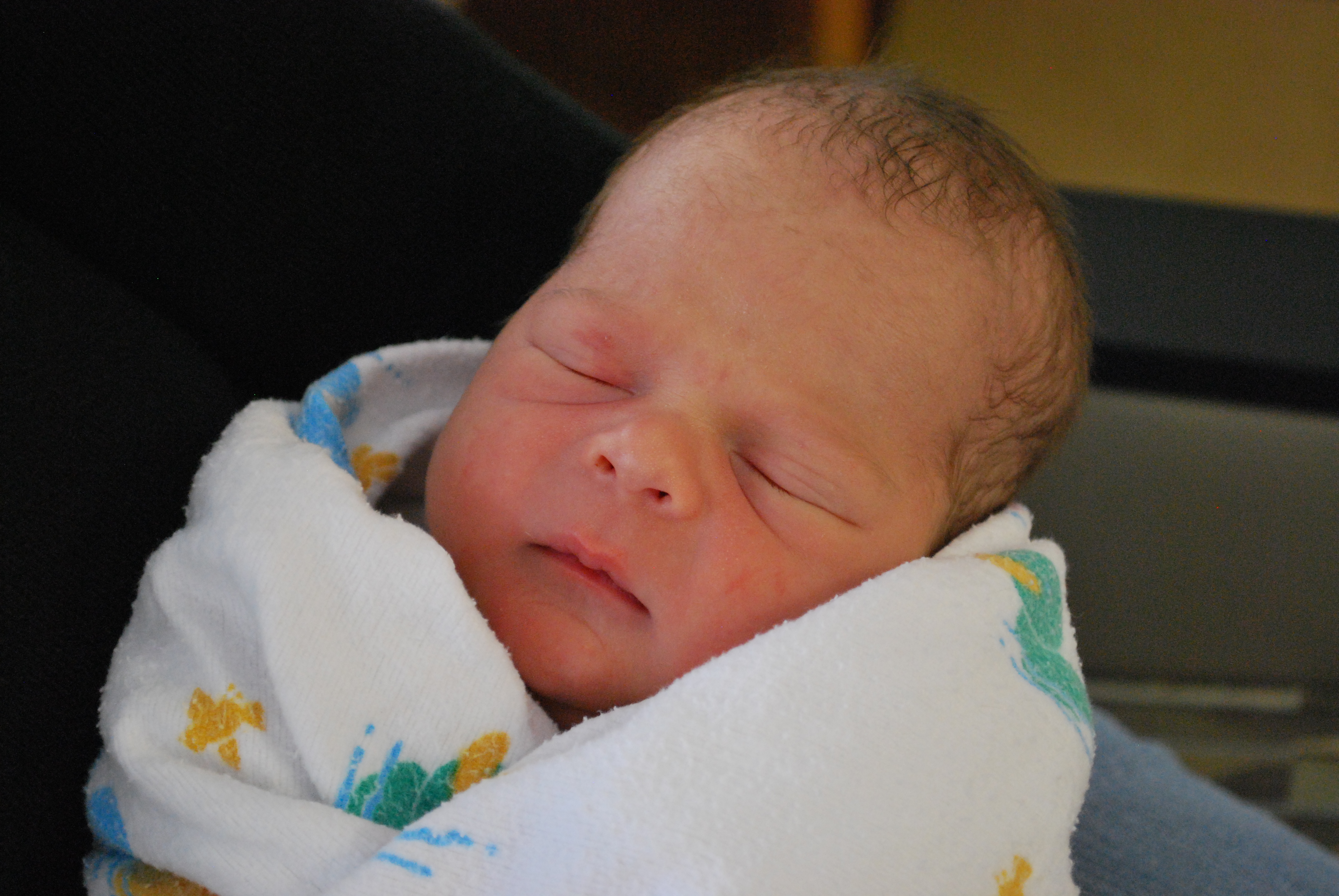
So here he is, folks.
Our Boy
March 7, 2014
2:02 PM
7 lbs, 6 oz.
19.5” long
Perfect.
 Mommy Jogger